Neocentric Dreams

Galaxy Brain
Reality is a process. An endless flow of time and space. A continuous, dynamic state “of becoming.” Within this temporal stream of cosmic dust, countless eddies take shape, systems form. Circular flows swirl and change, collapse and reform. New processes, new systems, a maelstrom of stars, galaxies. Processes within systems, systems within process, solar system, evolutionary process, ecosystem, mankind emerges and history unfolds. More processes, more systems, manufacturing process, political system. From universe to atom, particle and wave, it’s turtles all the way down.
This isn’t some fever dream, there is a method to the madness. It is the metaphysical fusion of Process Philosophy and Systems Theory.
So what is Process Philosophy and Systems Theory?
Process philosophy is an approach to philosophy that sees that world as a continuous dynamic process of “becoming.” We are born, we grow old, then we die and our legacy is passed on through memory. Every day a person undergoes processes, driving to work, talking on the phone, going to bed, all process. Process philosophy provides an overarching framework for us to view the world, a roadmap to help navigate our lives and guide humanity’s future.
The “continuous interaction of processes” have a tendency to form boundaries, patterns, structures, they become “temporally stable and reliably recurrent.” They become systems, processes with circular flows. The processes we repeat everyday, of “re-becoming,” are explained through Systems Theory.
Human consciousness is the product of deterministic forces, the result of the logic of the system. Consciousness is also a gift, a system, a tool we use to become more than the sum of our parts. We developed language systems to communicate our ideas, writing systems to preserve and pass on those ideas across generations, developed better systems such as physics, science and math to refine our understanding of reality. We observe the present, reflect on the past and plan for the future.
From Firmament to Foundation
The road to a new ideology needs a firm foundation, fundamental truths or principles to guide humanity forward. Neocentrism embraces a holistic approach to the dynamic nature of reality and the interconnected systems it forms. Now that we are in a system thinking frame of mind, we can now discover human values, but first we should start at the beginning.
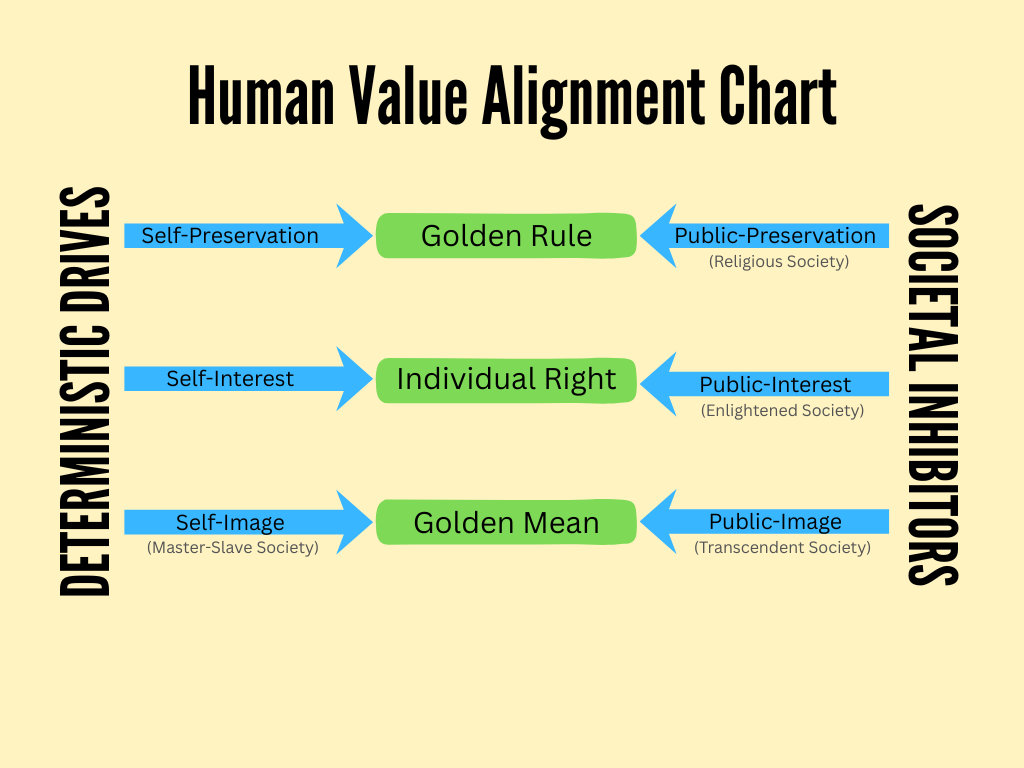
When life emerged, when non-living systems became living systems, the structure of the systems increased in complexity. The deterministic forces that interacted with the precursors to life necessitated the production of an advanced version of itself. A resilient, self-organizing organic system hard-wired with the deterministic drive of self-preservation. Self-preservation can be described as a set of overlapping cybernetic control mechanisms designed to maintain the organism, such as metabolic regulation and quorum sensing.
The process of evolution continued, multitudes of organic systems interacting with other systems, becoming and re-becoming. Life slowly trends towards better adapted forms in response to all these interactions with its environment. Self-preservation undergoes a continuous process of advancement, from it emerges a second deterministic drive, self-interest. Self-interest can be seen as an extension of self-preservation, in its rudimentary form we can consider things like the foraging patterns, reproductive strategies and parental investment found in invertebrates.
As we move further along the process, we hit some important milestones: mimetic behavior emerges and becomes more complex which in turn facilitates the rise of social behavior. In primates, this mimetic behavior is an adaptation used for social learning to enhance survival and cooperation within the group. Now we arrive to humans, this mimetic and social behavior gave rise to human consciousness. An ancestor long ago recognized their own reflection in a pool of water, and the drive of self-image, or consciousness of self, was born. In other words, self-image is our consciousness turned inward to define who we are, how we want others to see us and who we wish to become.
Standing on the Plane of Immanence
“I think therefore I am,” but also “they think, therefore they are as I am.” The self-image seeks out connection, recognizes the consciousness of others and a “consciousness of the consciousnesses” awakens. A tribe, kindred spirits, through the use of language and symbols, construct a system of beliefs to preserve the group consciousness and foster its development in new members. In a nutshell, the individuals of the group adopt the universal normative value, or indeterminate inhibitor, of public-preservation and a society is born.
Within the group, a social contract is struck. The self-preservation of the individual and the public-preservation of society align, encapsulated in The Golden Rule: “So in everything, do unto others as you would have them do unto you,” (Matthew 7:12). A sacred symbol absorbs the meaning of the doctrine, a system of governance erected to articulate and enforce the laws derived from that doctrine and to provide common defense and promote general welfare.
Consciousness is a sliding scale, individually and collectively. Its progress is not a straight line, the deterministic drives of the individual informs societal values and vice versa, the group consciousness undergoes a “process of difference” in the formation of a social identity. Our minds are the product of a primal world, environmental pressures necessitated psychological mechanisms to increase survival odds. Humans evolved cybernetic heuristic mechanisms such as the generalization and categorization of information, to quickly identify friend or foe.
As the structure of society becomes increasingly complex, it absorbs individuals and groups of wide-ranging physical characteristics and beliefs, it becomes more diverse. Societies gradually shift from that based on race, then to religion and in its current iteration to nationality. The value of public-interest emerges to align with self-interest and is derived from the collective consciousness of modern societies to leverage the strength of diversity.
Public-interest encompasses the collective well-being and engagement of members of society and is best expressed in the core tenet of liberalism. “Each person has an equal right to the most extensive total system of equal basic liberties compatible with a similar system of liberty for all.” (Rawls’ Original Position). The importance of public-interest is that society flourishes when each individual respects the right of others to be an individual, and for society to protect those rights regardless of superficial differences, those who fail to do so are not members of society.
The third value that emerges, public-image, serves as a collective mirror of society. These are the ideals a society strives for, to break free of determinism and choose its own future. It steps outside of itself and looks inwards to examine the structure of its systems and identify problematic components that threaten the longevity of society, such as divisive ideologies and wealth accumulation. Public-image aligns with self-image and is expressed in the Golden Mean. “Observe due measure; moderation is best in all things,” (Hesiod). At this stage, a society evaluates itself, defines itself and consciously guides humanity towards a better future.
Blind Gods of the Dark Forest
The advent of artificial intelligence, or rather the simulacra of AI, has as a central point of discussion, the problem of AI alignment. How to ensure a hypothetical alien super-intelligence would align with human values. If we ignore the fact genuine artificial intelligence is wholly in the realm of speculative science fiction, we still have the problem of whether the owners of the technology mean humans in general or simply the ones who control the technology.
The real question is: do humans align with human values?
Every individual is born with deterministic drives (nature) and most develop societal inhibitors (nurture) as they are raised. Typically, this alignment is strongest among family and others considered part of the “tribe.” However, these connections weaken as we expand outward to the whole of a society, and vary between individuals and groups. Some adhere to societal inhibitors through belief in something greater than themselves, who believe in the ideals of their society, some only do so out of fear of punishment for violating the rules established by society.
Ideally, a society should foster the development of the three societal doctrines: public-preservation (Golden Rule) for society to exist, public-interest (Individual Right) for society to flourish and public-image (Golden Mean) to endure. Unfortunately, we live in a world far from the ideal. Under global neoliberal capitalism, the cultural belief is that “society does not exist",” only the atomized hyper-individual, the “rational” economic man, slave to their own deterministic drives exists. This belief slows and even reverses human progress, confining humanity to a master-slave society, one in which the ruler or ruling class projects their own self-image onto society. A society where a small group of individuals are beyond any legal and moral restrictions, who commit the most heinous of crimes with impunity.
Whether a product of nature or nurture, dark triad personality types lack humanity. This lack is filled with the desire to possess and destroy humanity, thus these types (psychopaths, Machiavellians and narcissists) gravitate towards positions of power, to shape the world in their own twisted image into a master-slave society. A society plagued by despotic rulers, avaricious oligarchs, sycophantic politicians and populist hordes, is one destined for decline and collapse.
Decades of neoliberalism (deregulation, globalization, free trade) and its axiomatic principle of survival-of-the-fittest, unfettered self-interest as the highest virtue and self-image over character, brings the world to the edge of annihilation. Wealth accumulation is a violation of the Golden Mean, and from a systems perspective it is evidence of a reinforcing feedback loop. A vicious circle forms in which extreme wealth inequality leads to societal collapse.
The groundswell of reactionary populism across the globe is not some random occurrence, it is the natural response to a decaying system on the verge of collapse. Populist demagogues with the aide of corporate propaganda captured these destructive forces and direct its reactionary energy against the last bastions of democracy and freedom, against the foundations of truth and justice, against all that is liberal and good in this world.
America is starved for change, any change at all. So desperate for that change, many fell prey to the honeyed lies of charlatans, grifters and thieves. Instead of a leader, we find ourselves at the mercy of a gormless obscenity, a noxious greed-beast with hordes of sycophantic rats in tow. Neoliberalism is the cause, born out of the ignorance of its ideology, the immiseration of the masses, the rise of fascism and the death of freedom the outcome. It’s time for something new, something better.
Searing White Light Through Your Brain Pilled
We live in a deterministic universe, an endless series of cause and effect. One in which extreme wealth inequality has caused the decline and fall of civilizations throughout human history. Human consciousness is a transcendental movement away from pure determinism, ignorance is sin in a world where we have the real potential to guide our own fate.
Neocentrism is the idea that society must make the best decisions with the use of scientific principles including process philosophy and systems theory, and organized to filter out the darker impulses of human nature from wielding power. Self-interest in itself is neither good nor evil, it drives innovation, but without “guardrails,” its excesses lead us down “The Road to Serfdom,” (pun intended). Neocentrism strives to provide a balancing force against these excesses, to mitigate the unbridled self-interest, sin and vice heralded by the elite. It should be assumed that “rational, economic man” operates under the Principle of Evil, that every action is based on pure self-interest without any regard for the well-being of others unless it aligns with their own self-interest. Left unchecked, wealth and power accumulate to the top, to the point a small few with outsized influence break society.
Democracy is meant as a control mechanism to mitigate corruption and tyranny, but is only effective when the electorate is engaged and informed public. Between juggling work, family, school and life in general, people do not have the time nor energy to devote all their attention 24/7 on political spectacle. That is the original intent of media systems (Internet, radio, television and newspaper), to keep the public informed. This is only possible if the media system’s values are aligned with public values, otherwise democracy decays and erodes.
So what can be done?
The best approach to fight corruption is to formalize the “fourth estate” by the establishment of a new branch of government. One that consists of randomly selected American citizens, to spend a term in office, whose job is to observe the actions of public servants and assign points that add to or subtract from a political “credit score.”
The rating could be based on things like: Do their actions align with the constitution? What about campaign promises? The general good? Is the public servant consistently honest and transparent? Has their actions been mostly on enriching themselves at the expense of the nation? Do they accept corporate and special interest money?
The credit score would be required to be displayed on every political advertisement and news story about the individual. This would strengthen democracy by cutting through the obfuscation of corporate media and political theater, a quick-reference method for a better informed public, and when a government official’s score falls below a certain threshold, that individual is removed and permanently barred from office, and blacklisted from any other position which interacts with government (such as lobbying).
Of course, this is not a cure-all, and the greatest hurtle is how to force politicians to implement. The idea of reinforcing democracy is meant to ensure politicians’ self-interest remains aligned to public-interest. All other necessary changes America needs would be in vain without it. Money must be out of politics (revoke Citizens United), monopolies must be broken up (enforce and enhance anti-trust laws) and laws must be enforced equally regardless of wealth and status, but none of that happens without a fundamental change to society to negate corruption.